The Vet Said My Blind Racehorse Should Be Put Down. A Little Goat From the Farm Next Door Disagreed, and Moved Into His Stall
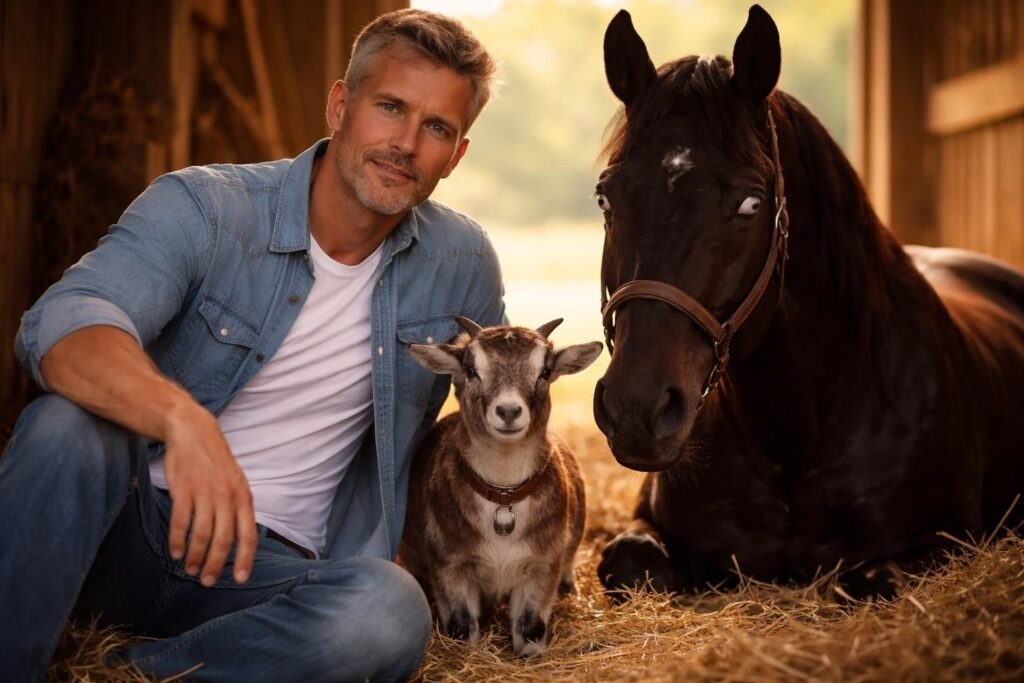
Her name, according to the tag on her collar, was Biscuit.
She was a pygmy goat, about the size of a cocker spaniel, and she belonged to the Yoder family, the Amish farm on the other side of my back fence.
She’d been escaping her pen for years. She had done it so many times that the Yoder kids had stopped chasing her.
And she had, at some point during the night, squeezed through my fence, crossed my pasture, slipped under the stall door, and walked right up to a terrified twelve-hundred-pound blind thoroughbred.
Charlie wasn’t trembling.
He had his head down low, his nose touching her back. And Biscuit was just standing there, chewing hay, her little bell going *tink, tink, tink* every time she moved.
I didn’t breathe.
Biscuit walked to the water bucket.
*Tink, tink, tink.*
Charlie followed the sound.
He found the bucket. He drank.
For the first time in two weeks, he drank for a full minute.
Then Biscuit walked to the hay rack.
*Tink, tink.*
Charlie followed her and ate.
I sat down in the straw outside the stall and put my face in my hands, and I’m not too proud to tell you I cried like a baby.
Elijah Yoder came over at seven to get his goat. He’s sixty, with a long gray beard and a straw hat. He stood at the stall door with his hands in his pockets and watched for a while.
“She has never stayed anywhere this long,” he said.
“Elijah,” I said. “How much do you want for her?”
He looked at Biscuit. He looked at Charlie.
“I think,” he said slowly, “she has already decided where she lives.”
He wouldn’t take my money.
He did take a pie, which my sister baked.
That’s how business is done in Wayne County.